From connecting banks to connecting infrastructures: SWIFT’s next challenge

For decades, one of the financial industry’s biggest challenges was enabling institutions in different countries to communicate securely, efficiently and through common standards.
SWIFT was created to solve precisely that problem.
More than fifty years later, the challenge is changing. Banks still need to connect with each other, but they now also need to operate across a growing number of infrastructures, technologies and new ways of representing and moving money and assets.
Instant payments, new regional infrastructures, DLT platforms, tokenised assets and tokenised deposits are expanding what is possible across financial markets. At the same time, they are adding new layers of complexity.
The question is no longer only how to build new ecosystems. It is how to make them work together.
The risk of creating new silos
Financial innovation is moving in several directions at once.
Traditional payment, clearing and settlement systems now coexist with instant payment infrastructures and are beginning to interact with DLT-based platforms and new digital forms of money and assets.
It is difficult to imagine one technology or one network replacing everything that came before it.
For quite some time, financial institutions will have to operate across both worlds.
And that creates a paradox.
A new infrastructure may solve a particular use case very efficiently, but it can also become another silo if it cannot interact easily with the rest of the financial ecosystem.
Tokenising an asset is only part of the challenge. That asset still needs to be bought, sold, settled and held in custody, and its lifecycle events need to be managed. The money, the asset and the participants involved will not necessarily sit on the same infrastructure.
For financial institutions, the challenge therefore shifts from adopting a new technology to operating across several technologies without multiplying connections, processes and operational costs.
This is becoming one of the defining questions of the next stage of financial transformation.
The role of interoperability
This is where SWIFT’s role is beginning to evolve.
For decades, its main contribution has been to connect the financial community through shared infrastructure, standards and rules.
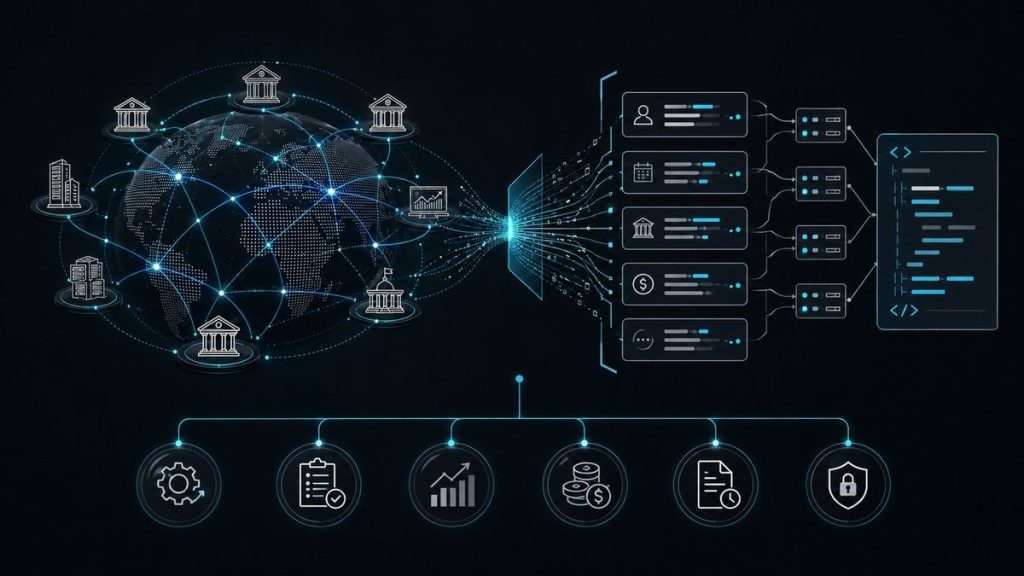
The challenge now is to extend that connectivity to ecosystems built on different technologies, operating models and ways of representing assets.
One infrastructure does not necessarily need to replace another.
They need to be able to interact.
Interoperability therefore goes well beyond technical connectivity. Information must be able to move between systems while remaining understandable and processable, but institutions also need to address identity, security, compliance, governance and operating models.
This matters particularly for banks.
If every new platform requires a dedicated integration, new processes and additional operational layers, part of the value promised by innovation can quickly be lost in complexity.
The objective should be the opposite: to introduce new capabilities without continuously rebuilding the infrastructure that connects them.
ISO 20022: a common language for a more complex ecosystem
ISO 20022 continues to play an important role in this environment.
SWIFT and ISO 20022 are often discussed together, but they perform different functions. SWIFT provides infrastructure and connectivity services for the financial community, while ISO 20022 provides a common model for structuring the information exchanged between participants.
And its relevance extends well beyond the migration away from MT messages.
ISO 20022 is used across payments, securities, cash management, corporate actions and other areas of financial operations, enabling institutions to work with richer and more structured information.
That is where much of its value lies.
The more diverse the technology ecosystem becomes, the more important it is to have information models that allow different systems to interpret data consistently.
Moving to ISO 20022 should therefore not be seen simply as a format change. Its real potential lies in what institutions can do with that data afterwards: automate processes, improve reconciliation, reduce exceptions and reuse information across different parts of the operating model.
From experimentation to real infrastructure
SWIFT has spent several years exploring how this concept of interoperability can be applied to new ecosystems.
Working with banks, custodians, market infrastructures and technology providers, it has tested ways of connecting blockchain networks with traditional financial systems and enabling transactions across different infrastructures.
These initiatives have included transfers between networks, subscriptions and redemptions of tokenised funds, Delivery versus Payment settlement for digital bonds and different scenarios involving CBDCs.
The logic behind these projects is important: avoiding a situation in which every institution has to build a different integration with every new platform.
More recently, that work has moved a significant step forward.
In July 2026, Swift announced that its blockchain-based ledger was ready for initial use, with 17 banks across six continents preparing to pilot live transactions using tokenised deposits, with a focus on enabling 24/7 cross-border payments and improving liquidity efficiency.
The model is also interesting because of how it interacts with the existing financial infrastructure.
Swift operates the ledger, while participating institutions retain control over their assets and funding, with settlement continuing outside the ledger through existing infrastructure.
The idea is therefore not to start again from scratch.
It is to introduce a new layer into a financial ecosystem that will continue to depend on multiple infrastructures.
That coexistence between new and existing systems is probably a more realistic picture of the industry’s near-term future than any scenario based on replacing today’s infrastructure entirely.
Technology is not the only barrier
There is another aspect of financial innovation that is often underestimated.
Technology can be developed relatively quickly.
Getting thousands of institutions to operate under common rules is considerably harder.
And this is where SWIFT has an asset that cannot be built overnight: its community.
Banks, central banks, custodians, market infrastructures, asset managers, brokers and large corporates have spent decades collaborating around shared standards, practices and mechanisms.
That experience may become particularly valuable in the environment now taking shape.
For tokenisation, digital assets or any new financial infrastructure to scale, solving the technical transaction is not enough.
The industry also needs shared rules, security, standards, compliance, governance and sufficient adoption.
That is why looking at SWIFT’s future role purely from a technology perspective may miss part of the picture.
Its ability to bring a global community together around common industry challenges could prove just as important.
What does this mean for financial institutions?
For banks, this evolution creates new opportunities, but also raises important strategic and operational decisions.
It will become increasingly uncommon to operate within a single, clearly defined technology environment.
The same institution may need to coexist with traditional infrastructures, instant payment systems, new messaging models, tokenised assets and future digital infrastructures.
The challenge will be to introduce these new possibilities without losing control of day-to-day operations. That means thinking not only about interoperability, but also about architecture, data models, traceability, reconciliation, security and the ability to integrate new infrastructures without continuously creating new point-to-point connections.
At ARENA, we have been working for years precisely at this intersection between financial expertise and technology, across payments, SWIFT, ISO 20022, securities, corporate actions, collateral, reconciliation, reporting and infrastructure integration.
And one conclusion is becoming increasingly clear across transformation projects: adding a new technology does not remove the complexity that already exists.
Real transformation lies in making new technologies coexist with existing systems in a controlled, traceable and efficient way.