
European interoperability: a strategic challenge for the financial sector

European interoperability aims to enable different systems, organisations and infrastructures to exchange information securely and efficiently, without losing its meaning. In public administrations, it facilitates cross-border services related to healthcare, transport and tax procedures. In the financial sector, the challenge is particularly complex: banks, payment service providers and market infrastructures need to exchange information and operate together, even when they use different technologies, formats and procedures.
Achieving this goal is not simply about connecting technologies. It also requires agreement on formats, concepts, responsibilities and security mechanisms. Although interoperability in public administrations and the financial sector shares many of these principles, their needs and regulatory frameworks differ. In the financial sector, there is an additional challenge: systems must not only understand each other but also ensure that transactions are processed correctly from end to end.
Key Challenges of Financial Interoperability
Connecting different financial systems is not always straightforward. Each institution has its own applications, processes and requirements, and ensuring they all work together presents challenges that go beyond technology.
Alongside technical challenges, there are others related to data interpretation, process organisation and security. Addressing these is essential to prevent greater connectivity from creating new risks or additional operational costs.
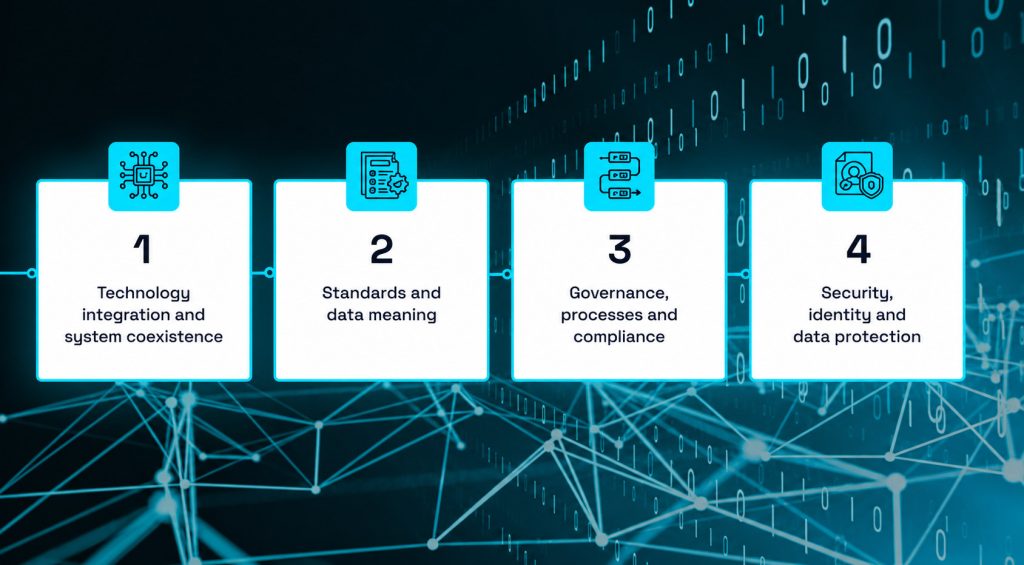
1. Technology Integration and System Coexistence
Financial institutions often operate applications and platforms developed at different times, with different architectures, interfaces and update cycles. Connecting them requires analysing how they communicate, adapting information flows and managing dependencies between systems. APIs and other integration tools facilitate this connectivity, but they also require appropriate controls, documentation and maintenance.
The coexistence of legacy infrastructures and new digital environments adds complexity. Poorly designed integration can increase operational costs, make traceability more difficult or affect service continuity. That is why interoperability must be approached as a controlled process, rather than a one-off connection.
2. Standards and Data Meaning
Exchanging data does not guarantee that systems interpret it in the same way. For information to be useful, institutions must agree on structures, definitions and validation rules, while also managing differences in terminology, formats and data quality.
In financial services, standards such as ISO 20022 help structure information and facilitate its exchange between systems. However, using the same standard does not mean that every challenge has been resolved. Institutions must ensure that data is transformed correctly, retains its meaning and remains consistent throughout the entire process, particularly when different applications and infrastructures are involved.
3. Governance, Processes and Compliance
Interoperability also requires coordination between teams, providers and organisations with different responsibilities and procedures. It is essential to establish who maintains the standards, how changes are managed, which controls are applied and how incidents are resolved. Documentation and version management become particularly important when a change in one system can affect other participants.
In the financial sector, this coordination is made more complex by evolving standards and regulatory requirements. Changes to messaging formats, validation rules or reporting requirements may require several systems and processes to be adapted simultaneously. One of the key interoperability challenges is therefore enabling institutions to implement these changes without disrupting their operations or multiplying the need for bespoke developments.
4. Security, Identity and Data Protection
Connecting systems creates more opportunities for information exchange, but it also requires stronger security measures. Institutions must establish appropriate authentication and authorisation mechanisms, protect information during transmission and define controls for access, traceability and incident response.
The design of these solutions must take data protection and applicable obligations into account, including the General Data Protection Regulation (GDPR) where relevant. The aim is to enable information to be shared between the participants who need it, while maintaining the necessary safeguards for confidentiality, integrity and control over its use.
Payments and Digital Assets: Moving Forward Without Creating New Barriers
Europe has various payment solutions that have achieved widespread adoption in their respective national markets but do not always support cross-border transactions. Connecting them would allow users to make cross-border payments through their existing applications, without having to use a different solution. Achieving this requires more than technical connections: it also calls for agreements between participants, common rules and mechanisms to ensure that payments are processed correctly.
A recent example of this progress is the creation of European Network for Payments (ENP), announced on 30 September 2026 during Sibos in Miami. The initiative brings together Bancomat, Bizum, EPI/Wero, SIBS–MB WAY and Vipps MobilePay, which have established a Madrid-based entity to develop and manage a shared interoperability hub.
Together, these payment solutions serve approximately 130 million users across 13 European countries. The objective is to enable users to make cross-border payments through their existing applications, starting with person-to-person payments and subsequently expanding to physical and online merchants. The initiative is currently in the implementation phase, with its functionalities set to be rolled out progressively.
What makes this model particularly interesting is that it does not aim to replace national payment solutions with a single European application, but rather to build on existing solutions and connect them. This offers a way to move towards a more integrated payments market while preserving the infrastructures and services developed by each country.
Interoperability will also play an important role in the development of digital assets. Tokenisation is giving rise to new platforms and ways of representing and transferring assets, which will need to coexist with traditional financial infrastructures. The challenge is not simply enabling these platforms to exchange information, but ensuring that transactions can be completed when assets, money and participants are located across different systems.
This landscape also includes new digital forms of money, such as tokenised deposits and the future digital euro, each with different characteristics and operating models. Their coexistence with existing payment and settlement systems presents new integration challenges. Common standards such as ISO 20022 can facilitate information exchange, but mechanisms will also be needed to connect different infrastructures and coordinate their processes.
Payments and Digital Assets: Moving Forward Without Creating New Barriers
In practice, effective interoperability also depends on data quality. A financial institution may have connected its systems and still encounter problems if information arrives incomplete, fields are interpreted differently or transformations introduce errors. That is why ensuring that information retains its quality and meaning throughout the entire process is just as important as connecting the systems themselves.
At ARENA, we work on precisely these challenges, helping financial institutions connect systems, adapt messaging formats and standards, and improve control over the information they exchange. Our experience in data integration and transformation allows us to address these needs from both a technical and business process perspective. Because it is not just about ensuring that information reaches its destination, but also about making sure it can be used correctly and with the necessary safeguards.
Europe will continue to make progress in connecting its financial systems, both traditional and digital. The challenge will be to ensure that institutions can operate across them simply, securely and efficiently. Developing new infrastructures will be important, but so will making better use of existing ones and enabling them to work together.